
Influencer Marketing Platform vs Agency: Who Does What?
Choosing between an influencer marketing platform and an agency often comes down to one hope: hand over the brief and get your week back. Then a creator goes quiet, the video misses the point, and somebody on your team is back in the inbox.
Choose a platform if you have an operator who can run the campaign. Choose a managed service if you need someone else to own agreed day-to-day work. If your team can run most of the campaign and one handoff keeps breaking, ask for help with that handoff. The choice hinges on who does the work when something goes wrong.
QuickAds publishes this comparison and sells creator software and managed services. Apply the same operational test to its offer as to any other. Run the same scenario through each proposal and ask for the operator, the person approving the work, and the person who steps in when a deadline slips.
Use the same brief to compare each option
A fictional language-learning app wants three creator videos: two for commuters who can practise in short sessions and one for people preparing for a trip. Use a demo account and show one lesson. The buyer needs three accepted 9:16 files within ten business days of brief acceptance, one in-scope correction per file and U.S. paid use from its own brand handle for 30 days from the first paid delivery. Creator posting and use of a creator’s handle are outside this pilot. The app's marketing lead can approve claims and spend. The team has an editor and a media buyer, but nobody has room to follow up with creators every day.
This is an invented example, not a QuickAds engagement, service guarantee or price quote. Bring a brief like this into every demo. Don't ask the platform to show an effortless campaign while asking the agency how it deals with the worst possible customer. Use the same work, rights, delivery dates and acceptance checks. First reject any offer without a named owner for corrective work and authority to route the revised file to the buyer’s final approver.
| Operating model | Who runs the day-to-day work | What the buyer should be ready to do | When it fits the app team |
|---|---|---|---|
| Platform, self-serve | Buyer-side campaign operator, using available software and automation | Provide a named operator, set approvals, follow up and own delivery | Only if the lead reallocates coordination to someone with time and authority |
| Platform with scoped help | Buyer owns the campaign; supplier runs specific tasks in the agreement | Decide what to delegate and who checks the handoff | Fits if outreach or revision coordination is the only bottleneck |
| Managed agency or creator service | Supplier's named lead runs agreed operations, with a backup | Supply product facts, budget and timely agreed approvals | Fits if both outreach and revision management need to move off the buyer's plate |
A managed label doesn't tell you if revisions are included. A platform subscription doesn't tell you whether the supplier has promised to run anything. Some suppliers offer both models. Compare the actual operating arrangement, including named people and who gets access, rather than scoring the label.
Map the handoffs before looking at the proposal total
For each stage there should be somebody responsible for moving it forward and somebody who can stop it. Those roles may sit with different organisations. Whoever enters a creator's quote into a tracker, for example, isn't necessarily the person authorised to accept it. A tool can organise quotes and prepare messages; that doesn't transfer spending authority.
For the fictional pilot, assume that both models use the same buyer's marketing lead to approve product claims, budget and final work. The right column shows a proposed division for a managed agreement, not a vendor's default:
| Stage | Buyer running a platform | Buyer and supplier in a possible managed scope |
|---|---|---|
| Product facts and brief | Marketing lead supplies a demo account and approves claims; operator writes the brief | Buyer owns product facts and approves; supplier lead translates them into a creator brief |
| Search and screening | Operator checks work samples and shortlists candidates | Supplier lead checks samples and sends reasons; buyer approves shortlisted candidates if required |
| Outreach and negotiation | Operator follows up and presents quotes within budget | Supplier coordinator runs outreach and follow-ups; buyer approves commitments against the agreed cap |
| Production and revisions | Operator gathers one set of feedback; editor checks the replacement | Supplier reviews first cut and coordinates revisions; buyer confirms corrected claims and accepts the final version |
| Rights and files | Operator verifies licence, file spec and approved destination | Supplier obtains written terms and hands over the asset and rights log; buyer's media operator checks before launch |
| Payment | Buyer finance pays under approved terms | Supplier shows who invoices and when; buyer finance approves amounts and pays the responsible party |
| Launch and reporting | Media buyer launches and records results | Buyer media team retains launch in this example; supplier reports delivery unless campaign management is separately agreed |
The same person can own several rows in a small team. Write their name anyway. Leave a gap visible if nobody has agreed to it. “The creative team will handle it” can hide the fact that the editor has time to check a file but no authority to negotiate or contact the creator.
If you're keeping media in-house, set a clear boundary for the handoff. The supplier can deliver an accepted asset and written permission. Your media buyer can decide when to launch and monitor spend. If you want the agency to run ads or optimise a campaign too, name the accounts, access, spend authority, reporting and review cadence in its own line. An agreement about creative production doesn't automatically include campaign management.
Make the buyer's work visible as well
A managed proposal can shift coordination, but your team still has to hold up its side. Assign someone to supply approved demo footage or a restricted test account, not production credentials. Assign an owner for a single source for supported claims, a budget and an approval deadline. Name a backup if the product approver is away. If multiple people review, give the supplier one consolidated response so the creator isn't reconciling two incompatible requests.
Ask what happens when your team misses its approval time. Does the creator's slot move? Does the next deliverable move with it? Is there a change fee, and who must approve it? This belongs in the plan too. Otherwise a supplier can appear late because the buyer's own review wasn't staffed, and neither side understands the next available date.
Ask the supplier to walk through a bad first cut
In the fictional pilot, the first creator says an offline lesson will update the learner's saved progress from any device. The approved demo only shows progress syncing after reconnection. There are two days left before delivery. Ask every supplier to talk through that precise problem.
A useful answer names four steps. Someone on first review compares the claim with the approved brief. One coordinator pauses acceptance and sends a single correction to the creator. The product approver checks that the revised explanation is accurate. The person who accepts the final file confirms whether the deadline still holds. Write down the expected handoff and where it will appear. The buyer says hold when the first cut fails; it accepts only after the replacement removes the unsupported line, the named product reviewer clears it, and the rights and deadline still match. If the replacement misses the deadline, log it as late even if the buyer eventually approves it.
For a separate fictional example, open the QuickAds responsibility worksheet and choose 2. Compare. It shows who supplies the correction, coordinates the revision and checks the replacement.
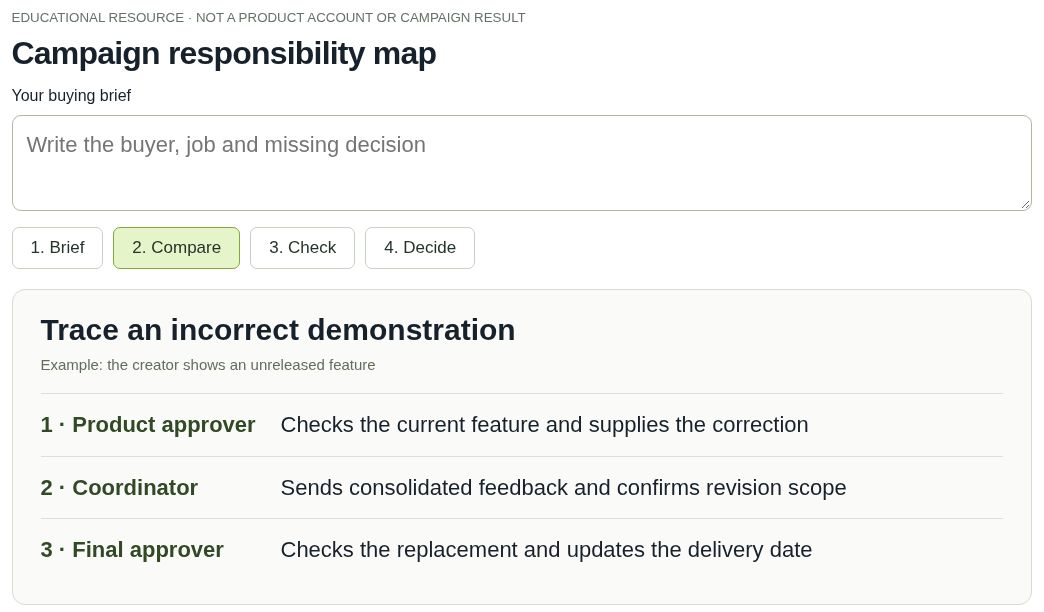
Under self-serve, the buyer operator needs the time to run that loop even if the platform can draft a note or send reminders. Under managed service, the supplier can be responsible for chasing the replacement when that work is included, while the buyer still approves the product claim. Under partial help, someone needs to state what the supplier's role ends with. “Send the consolidated feedback” and “obtain an accepted replacement” are different commitments.
Then ask one more question: what happens if the creator doesn't reply? Options might include using a contracted revision, agreeing a new date, approving a substitute or ending the booking under agreed terms. Decide who can choose each option and what happens to the fee. A replacement can change usage permissions and the footage itself. Do not assume a new creator inherits the old contract or automatically suits the brief.
Ask to see the record your team receives. It should let the buyer see the current state, who owns the next response and what remains unresolved. If the only place to see that is inside the supplier's inbox or a screenshot during the demo, ask how your team would recover the work during a handoff.
Check what automation can do without an approval
Ask the supplier to distinguish a suggested shortlist, a queued draft, a sent message and an agreed booking. A tool that can prepare messages may also be able to send them once something is enabled. You need to know who can enable it, who can pause it, and what shows that a person approved a new commitment. Walk through one ordinary example such as a rate above your cap, without creating a real message or booking in the demo.
For managed work, ask the same question of the human operator. Can the coordinator accept a revised amount if it is under a pre-agreed threshold, or must your marketing lead approve every quote? Decide which approach fits your team and record it. Give the supplier access only to the accounts and tasks the arrangement requires; you don't need to grant publishing access to get help screening work samples.
Compare all costs for an accepted deliverable
List software or service fees, creator payments, rights, revisions, editing, project coordination, any production expenses and media separately. Show your own staff time as hours before assigning it a cost. An offer can have a lower fee and still move ten hours of chasing and review onto a team that has no hours free.
Put the denominator beside each comparison. A quote for three commissioned videos doesn't promise that three have already passed acceptance. Track commissioned assets, first cuts received, accepted assets and accepted assets with usable rights. If the quality bar isn't written down, no cost-per-deliverable comparison will make ambivalence disappear.
For the app pilot, compare the expected cost of three accepted, usable 9:16 files, with the same usage period and the same level of editing. If one model includes a post that the other doesn't, remove it or quote it separately. If one expects the app team to rewrite drafts and coordinate revisions, include those hours rather than implying the offer transferred that labor.
Fictional matched comparison, not a provider rate. Self-serve cash: $450 software, $1,050 creator fees and $300 rights, or $1,800. The buyer plans two hours of product review plus seven hours of coordination at $60 an hour; total modeled cost is $2,340. Managed cash: $2,400 for the same three files, creator fees, rights and the included correction per file, with coordination supplied. The buyer still plans the same two review hours, so its total is $2,520. Both omit tax and media and assume no other fees. If all three files pass, the totals are $780 versus $840 per accepted, usable file. The managed route costs $180 more in the model and returns seven buyer hours. Verify both the accepted count and actual buyer hours at the pilot review.
For a performance-based quote, ask what event triggers payment, how it will be recorded and whether there is still a minimum commitment or separate fee. Clarify rights, who approves work, and what counts when a creator posts late or a report arrives after the window. Get the current written terms from any supplier before you assume what's included. A phrase on a pricing page doesn't tell you how your pilot will be invoiced.
Beyond the first fee, ask who can approve changes. More cutdowns, extended paid use, a different platform or an extra creator can all change the scope. Put a stop point in the proposal: no additional spend or commitment until the named buyer has approved the new line. You want the team to know which problems it can solve without waiting and which changes need a decision.
Buy the first pilot against your actual bottleneck
For the app team, ask for a managed quote that owns creator follow-up and revisions, with a single person accountable for delivery. The buyer should retain claims, approval and media. That fits the team's stated shortage. If the supplier won't own the revision loop and the team can't staff it, shrink the campaign before buying a larger package. More shortlisted creators would increase the work the team is trying to remove.
Set the end-of-pilot questions at the start. How many assets passed acceptance? How much buyer time went into exceptions? Which turnaround was the supplier's responsibility and which depended on the buyer? Did the buyer receive the scope, permission and final files in a form it can reuse? Did anyone miss an approval or do work that was never in the proposal?
Don't judge the operating model solely on early campaign performance. Disappointing ad results can be a problem with the message, audience or landing page even when delivery was well run. Track delivery and performance separately. A useful pilot can tell you whether this team and this supplier can do the job reliably before you buy much more from them.
Keep a short log during the pilot. For each exception, record when it appeared, who moved it, whether it waited on the buyer or the supplier, and how it was closed. Two similar delays can have different causes. If the supplier gathered revisions on time but three of your reviewers disagreed on the claim, fix your approval process. If your reviewer answered in an hour but nobody sent the consolidated change, the coordination you intended to buy may still be missing.
Ask who covers the work while the named lead is out. One agency contact who knows the product is helpful until that person goes on leave during the launch. An internal operator can be a single point of failure too. Give the backup the brief, the approvals and the list of open commitments, rather than asking them to monitor an inbox without authority to act.
Make the next handoff reversible
Agree what you will receive if you switch between self-serve and managed service, or change supplier. That can include the contact history your team is entitled to retain, accepted assets, permission dates, open revisions and the reporting record. Ask whether the useful information is available as a structured export or only inside a supplier account. Verify that your team receives the material it needs without taking personal data it has no reason to keep.
Record who can still approve changes after the transition, when supplier access ends and how the buyer will handle open usage renewals. Don't make a decision to change operators depend on someone reconstructing a campaign from memory. A simple wrap-up can save the next person a week of asking the same questions again.
Before the next campaign, look at the exception log together. Pick the one handoff that cost the most time or put the campaign at risk. Keep it with the same owner if it worked; change the scope or the person if it didn't. Buying more capacity without resolving that handoff usually leaves the next team with the same queue.
Name one shared place to record decisions. When the buyer approves a new date, capture the date, approver, affected deliverable and any fee change before anyone acts. A recorded approval lets the next operator leave the creator alone instead of reopening a commitment already made.
Compare QuickAds the same way
The QuickAds Remy product page describes self-serve and managed options for creator work: test what your team runs and which work the supplier offers to operate. The page is provider documentation, not an observed correction of this fictional failed cut. The separate QuickAds influencer service page describes the wider service. Which tasks, review rules and fees apply to your campaign should be explicit in the current proposal.
The wider services offer is relevant only for the contracted work you need done. Do not infer media management or spend authority from agreeing creative production. If you already have a media team, put launch and spend on your side of the map. If you want somebody to take the project from research and brief through production and reporting, ask for that scope by name rather than inferring it from the platform description.
Take one handoff into the demo: “We approve product claims and spend. Who gets us from the first cut to an accepted replacement if a creator gets a claim wrong?” Send the proposal back if it doesn't name the role, time and cost. You're buying the work written into the agreement, not the smoothest version of the demo.





Privacy is important to us, so you have the option of disabling certain types of storage that may not be necessary for the basic functioning of the website. Blocking categories may impact your experience on the website. View Our Privacy Policy


