
Influencer Platform Comparison: A Demo Checklist
A search for the best influencer marketing platforms can leave you with five polished demos and the same unanswered question: who will actually run this thing?
The useful comparison starts with your next campaign. Ask each supplier to find suitable creators, explain the evidence and show what happens when a video needs fixing. Then compare the work your team keeps. Here’s a practical way to evaluate Modash, Aspire, SideShift, Trybe and QuickAds without pretending one tool is best for everybody. QuickAds publishes this comparison and sells Remy. Apply the same evidence standard and buying constraints to it.
Suppose a small consumer-app team needs three creators to demonstrate one feature. They can approve product claims but have little time for coordination. A large discovery database may help; it does not settle their operating problem.
Use the five checks below as your live demo script. Record what was demonstrated, what was only described, what is missing and who must act. For broader vendor positioning and pricing, start with the platform comparison hub.
1. Give everyone the same unfinished brief
Give each supplier the same buyer, intended demonstration, delivery date and usage request. Here’s our fictional starting brief: a small app team needs three creators to show one feature to US English-speaking buyers. The feature turns meeting recordings into action items. The company can check product claims and approve cuts, but it cannot spend five hours each week chasing updates. It needs editable source files only if it plans to produce new cuts itself. Set one delivery target: three accepted cuts within ten business days after brief acceptance. Quote U.S. paid use from the brand’s handle only for 30 days from first paid delivery; no creator posting or creator-handle use in the base quote. Keep those constraints fixed for every walkthrough.
Leave one real question open on purpose: who can approve the script if the creator suggests showing a customer recording? A good response asks about consent and whether the team can supply a safe demo recording. It doesn’t silently write permission into the brief. Use a synthetic record with no private contacts or meeting audio. Record what the vendor asks, which person they expect to supply the input, and what happens if you cannot deliver it by the deadline.
The organizer should send the same version to each participant and ask for a proposed plan and a backup. If one vendor can’t assess the audience or edit scope, that’s a finding, not a reason to give them a different campaign. If their product is genuinely meant for a different job, mark it out of scope for this brief without inferring it is a bad tool for everybody.
2. Inspect a recommendation and one reason to reject it
Ask to open one recommendation, the relevant piece of content and whatever first-party or vendor data supports the fit. In our sample, a creator who makes commercial and customer-support tutorials may be a strong fit if the demonstration is clear and the evidence matches the audience you plan to reach. Reviewing the actual work is more useful than reading a tag that says “productivity.”
Then ask to reject a candidate for a reason your buyer cares about. Suppose the style and audience appear promising, but the relevant platform geography is missing. Ask the vendor to show where they would record that uncertainty, not to produce a convenient estimate. If they can only write “not available” in a handoff note, that may be enough for a small pilot. What matters is whether the next person sees the missing field and knows a booking is not yet approved. A fit score does not establish the accuracy of a demographic estimate. An unavailable metric is not a failed creator.
Classify the demo evidence in your notes. “Observed” means you saw the actual action and resulting state, whether the workspace is owned by you or supplied by the vendor. “Documented” means the supplier showed a relevant source or contract line but did not execute the workflow. “Stated” is a verbal claim. “Unknown” means no usable evidence. A vendor demo with seeded data may show an action in that workspace. It does not confirm your account, actual integration permissions or live delivery. A static product-page example stays documented, not observed. Don’t give a verbal claim the same status as a reproduced action.
3. Follow one rejected video and a second version
Ask the person who will actually manage the campaign to join the demo. Give them one failed fictional cut: it says the software joins every meeting automatically, but the product requires a host action. The timestamp is 00:08. Watch the operator find the version, record the error, notify the right owner and request a corrected edit. Then ask to see a replacement, distinguish it from the original and confirm that the approved version is the one ready to use. This is better than asking a presenter whether the product “supports revisions.”
Record where handoffs cross channels. It is fine for a formal approval to be outside the tool if the buyer can retrieve it and identify the approved file quickly. The problem is a workflow where every person assumes somebody else notified the creator or closed the old version. Ask what happens if the creator doesn’t respond before the deadline. If the proposal says a vendor handles this, ask for the responsible role, expected output and who gets notified if the SLA or schedule is at risk. Don’t infer a service guarantee from a successful simulated demo.
Use the same exception across vendors. If the presenter can demonstrate approvals but not replacement delivery, split the evidence rather than failing the entire stage. Keep “approval recorded” and “corrected file received” separate. In notes, record the original version, correction at 00:08, replacement version and final approver as four fields. A closed comment on the old cut does not prove the replacement arrived. Ask what you can export if a project ends or you change supplier. You don’t need a tour of every screen; you do need an answer about the work your team cannot afford to keep.
4. Compare the same finished scope and the cash due
Ask for a written quote that covers three accepted assets, one defined in-scope revision each, the specified usage rights and the actual needs of the people operating it. Ask to price another version separately if it adds creator posting, wider paid use or extra editing. Separate subscription, creator fees, services, paid-use, edits, tax, fees and internal time. Optional product costs belong in their own line, not hidden inside a starting subscription. Record how many deliverables the fee buys, the currency, payment date, refund or change restrictions and who approves an amendment.
In an illustrative buying model, Offer A charges $600 for software, $900 for creators and $180 for rights, so written external cost is $1,680. The buyer budgets six hours at $60 an hour: two for product review and four for coordination. That makes a comparable planning cost of $2,040. Offer B charges $2,050 externally for the same deliverables and rights, including creator fees and the coordination work. The buyer still budgets the same two hours of product review at $60, for $2,170 total. Both examples exclude tax and assume no other fees. A costs $130 less under those assumptions. B may still be useful if the four hours saved unblock a launch and the services scope really includes the failed handoff. Neither offer is a named supplier’s pricing, and internal time is not part of the cash invoice.
If Offer B can’t specify who corrects the wrong claim or whether the revised version costs more, its $2,170 is not comparable yet. Don’t give an unresolved cost a zero. Write the assumption, ask for the exact quote line and set a deadline. If both offers meet the scope, cost per accepted asset may help compare. If the team pre-pays for broader volume, keep the invoice amount, amount used by this brief and remaining credit distinct. A quarterly price divided by three is a run-rate, not necessarily what the business pays at signing.
5. Record a decision someone else can repeat
Use one shared template for all demos. Keep the sample brief revision, candidate evidence state, the exact failed revision, the quoted responsibilities, cost model, open questions and a named follow-up owner. Share a link to the authorized proof and keep draft clips and private customer details out of the buyer-facing worksheet. Mark the must-haves before the first call. Don’t add a favorite vendor’s strength as a must-have after the demos.
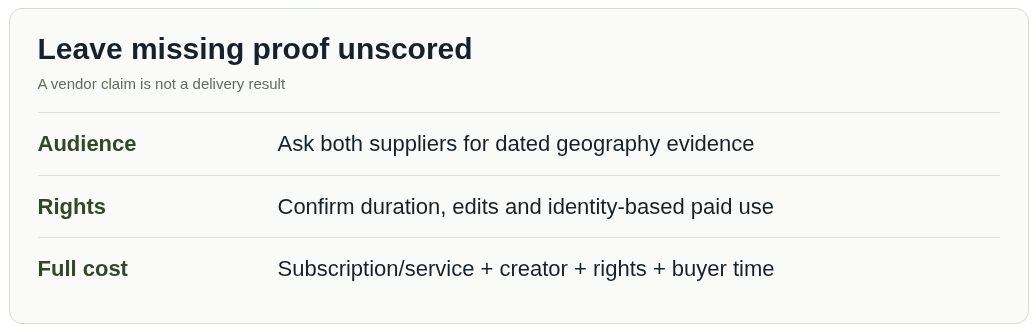
For an editable example, open the QuickAds One-brief comparison kit and choose 3. Check. It prompts you to document dated audience geography, usage rights and full costs. Leave missing evidence unscored and confirm only the usage rights your brief requires.
| Decision row | Minimum acceptable evidence | Example hold or disqualifier |
|---|---|---|
| Creator fit | One concrete example linked to the job and a dated audience check with gaps called out | The demonstrated candidate cannot make the required kind of video and no credible replacement is offered |
| Operator handoff | A failed cut followed through correction, with one named owner at each step | Nobody included in the offer can coordinate feedback and your team cannot take it on |
| Scope and rights | A written quote for the same deliverables, approved uses and commitment | The required paid use or source files are explicitly excluded and no acceptable alternative is quoted |
| Measurement and exit | A sample reporting or export path for the result you need to see | Your must-have record cannot be exported or reproduced and the fallback would prevent renewal review |
Make a small pilot decision, not a universal supplier ranking. A funded pilot could be one brief, one approved cut, one simulated revision and one explicit usage agreement. Decide what success would show: your team took fewer hours to get an acceptable file, or the operator had the correct audit record by the approval date. That is an operational test, not a promise of response rates, paid performance or customer adoption.
When someone wants to override a hold, ask them to write down what changed. An updated agreement, demonstrable handoff or a team member genuinely assigned to the missing work can change the decision. A polished slide or a verbal “we’ll figure it out” isn’t new evidence. In the fictional example the app company can defer the source file question if the approved test doesn’t require recuts, but can’t defer ownership of the product claim or final version. Make the distinction explicit. It lets your team try a narrower option without buying the wrong scope.
Make the result easy to hand to procurement. For every must-have, attach one sentence of proof and one sentence of limitation. An operator might write: “The presenter replaced a rejected sample in the demo workspace; our quoted plan and access are unconfirmed.” A procurement lead could then ask for the entitlement and responsible role without watching a recording. If the vendor won’t share a sandbox or recording, capture dated notes with permission and ask them to confirm the relevant step in writing. Don’t fill the gap with a screenshot for a different plan.
A shortlist is also a decision to stop evaluating certain options now. In the app example, pass through the provider that names the revision owner and agrees to the bounded trial. Hold the offer that requires the founder to coordinate every correction, and reconsider it only if the team assigns a coordinator. Neither judgment travels to another company. The next buyer might already have that role staffed.
Use the vendor shortlist as context, not a result
The comparison below describes public positioning, not a signed-in test or a ranking of campaign results. Vendor descriptions were checked in November 2026; Trybe’s public title was visible, but detailed terms were not. No current plan is assumed to include every advertised capability.
Modash
Public positioning to investigate: Discovery, management, tracking and creator payments; Shopify and email workflows
Question for your demo: Can you demonstrate our category, audience checks and paid-use handoff in the proposed plan?
Aspire
Public positioning to investigate: Creator discovery, program management, measurement and services
Question for your demo: Which work is software-supported and which human services are included?
SideShift
Public positioning to investigate: Creator campaigns, content tracking, payments and organic-to-paid workflows
Question for your demo: Who reviews the content and what evidence justifies testing it as an ad?
Trybe
Public positioning to investigate: Page title describes performance-based UGC; readable public detail was limited
Question for your demo: What are the current payment terms, training duties, review work and rights?
QuickAds
Public positioning to investigate: AI-assisted creator sourcing and a connected campaign workflow, with human review
Question for your demo: Show why a candidate fits, which checks remain and who owns each next action.
Which suppliers should you shortlist first?
Use the following as a route into a demo, not an independently tested winner list. These shortlist suggestions are editorial judgments from public positioning; your proposal must confirm the plan, scope and evidence.
A staffed e-commerce team wants creator discovery, program operations and Shopify-linked workflows
Start by evaluating: Modash; compare Aspire
Why it belongs on that shortlist: Their official sites describe discovery and program operations; Modash specifically lists Shopify workflows
What would rule the proposed offer out: Your actual integration, needed data or paid-use workflow is absent from the quoted plan
An e-commerce marketing leader wants to compare a platform with an optional services scope
Start by evaluating: Aspire
Why it belongs on that shortlist: Its public offer includes creator-program tools and a services route
What would rule the proposed offer out: The quoted human service leaves the critical coordination tasks with your team
A consumer-app team wants to evaluate an ongoing creator-content program and organic-to-paid testing
Start by evaluating: SideShift
Why it belongs on that shortlist: Its public workflow covers campaigns, content tracking, payments and taking ideas into paid ads
What would rule the proposed offer out: The proposal cannot explain review ownership, compensation or the evidence used to advance content into ads
A team wants explainable AI-assisted sourcing with separate audience review before the brief and outreach
Start by evaluating: QuickAds
Why it belongs on that shortlist: Remy’s published workflow describes sourcing, separate screening and preparation for outreach. Ask the presenter to trace those steps in your demo.
What would rule the proposed offer out: The live demo cannot support your actual category or resolve the checks your booking depends on
A team is investigating a performance-based UGC offer specifically
Start by evaluating: Trybe, after obtaining a current written proposal
Why it belongs on that shortlist: The public page title identifies that category; detailed readable terms were unavailable in this review
What would rule the proposed offer out: The provider cannot give sufficient detail to evaluate responsibilities, rights and payment events
Sources: Modash’s workflow and Shopify integration, Aspire’s platform and services, SideShift’s workflow, Trybe’s public page. Remy’s product page describes its offering. Vendor descriptions establish an advertised capability, not delivery quality or comparative campaign return.
Inspect the work behind a recommendation
Ask each supplier to open a relevant candidate from your brief, show the work behind the match and preserve the unresolved audience fields. A persuasive explanation is something to check, not a completed booking decision.
A staffed Shopify team and a founder with no campaign operator may leave the evaluation with different shortlists. That is a useful result. The mistake would be forcing them into the same ranking because one provider has the largest database or the cheapest entry plan.
Put the example to work
Copy this short demo record into a document rather than relying on a download. Put dated evidence beside the decision so procurement can test the argument later. For instance, if the agency showed the corrected cut but did not show who could approve it, mark revision handling demonstrated and approval authority unverified. They are different requirements; do not let a strong creative sample pull a separate operational check into the pass column.
| Field | What to enter |
|---|---|
| Candidate | Supplier, quoted plan, date, fixture version and who showed the work |
| Best evidence | Observed step, exact record or timestamp and what it does not show |
| Failed step | Rejected revision, proposed smallest fix and named decision owner |
| Follow-up | Remaining prerequisite, who can prove it and the date you need it |
Why include QuickAds in the comparison?
QuickAds publishes this article, and Remy is our AI-assisted, human-reviewed creator agent. The product walkthrough describes finding candidates and checking fit. Ask to see why one candidate was suggested, which audience evidence is missing and who owns the next decision. Then use the same 00:08 rejected cut and ask to see a replaced version, who can accept it and which plan includes that work. The product page doesn’t establish that Remy can complete that exact handoff for your account or that it outperforms the other suppliers.
Explore the QuickAds creator workflow. Use the same questions and demand the same evidence.
Questions before the next decision
What should I bring to an influencer platform demo?
Bring one product, buyer, market, intended demonstration and usage requirement. Ask every supplier to identify missing information and work through the same brief.
Can public feature pages establish the best platform?
They establish advertised capabilities, not delivery quality or campaign return. Confirm the quoted plan, human responsibilities and evidence through your own demo and pilot.
Keep the next decision connected
Continue with the broader platform and pricing comparison and the creator workflow · creative testing.



Privacy is important to us, so you have the option of disabling certain types of storage that may not be necessary for the basic functioning of the website. Blocking categories may impact your experience on the website. View Our Privacy Policy


