
Ad Creative Testing: Write the Next Brief From Results
When one ad holds more viewers and another records cheaper purchases, don’t ask for more versions of either one yet. Check what was actually comparable, choose one explanation worth testing, and brief the smallest edit that will help you make a decision. The next brief should say what changes, what stays fixed, which result matters, and what you will do if there isn’t enough evidence.
Here’s the process using a fictional desk cable organizer. No real advertiser, campaign, creator or performance report is represented. It comes with a filled brief you can copy, including the opening shots, the costs and the conditions for holding the next order.
1. Start with the decision, not the most impressive metric
The fictional brand sells a $48 cable organizer that sticks to a clean desktop. It has two paid creator ads. A, the desk makeover, opens on an overhead before-and-after. B, the cable drop, opens with a charging cord falling behind the desk, then shows the organizer catching it. A gets people to stay for the opening more often. B’s reported purchases cost less. The team has enough production budget for one revision, and the question is whether to commission it or leave the current ads alone.
Imagine this export covers the same prior seven days, uses one platform, and reports the same purchase event and attribution window for both ads. The ads ran together under ordinary optimized delivery, not in a randomized split. These invented figures are here to show the arithmetic and the limits of the comparison.
| Metric | A: desk makeover | B: cable drop |
|---|---|---|
| Media spend | $480 | $360 |
| Impressions | 20,000 | 12,000 |
| Three-second views | 7,400 | 2,880 |
| Three-second views ÷ impressions | 37% | 24% |
| Outbound clicks | 160 | 144 |
| Outbound clicks ÷ impressions | 0.80% | 1.20% |
| Platform-attributed purchases | 8 | 10 |
| Media spend ÷ attributed purchases | $60 | $36 |
Check the numbers someone could otherwise misread
The 37% and 24% use impressions as the denominator. That is the definition in this worksheet, not a universal definition of hook rate. The click row counts outbound clicks, not profile taps, likes or all clicks. The purchase figures are attributed to the ads by the platform, not independently verified incremental orders. One untracked purchase isn’t a zero on the business side, and a purchase the platform takes credit for isn’t necessarily an order the ad caused.
B’s lower observed cost per purchase is a reason to investigate the opening, not a reason to call it the winner. A had 8,000 more impressions, the spend differed, and regular campaign optimization may have shown each video to a different mix of people or placements. On these small counts, three additional attributed purchases for A would move its reported cost from $60 to about $43.64 even if its spend stayed fixed. The ranking can look more stable than the evidence behind it.
Before editing, get the reporting date range, time zone, purchase event, conversion window and placement breakdown. Check whether one ad ran while the product was out of stock, sent visitors to another page or was missing a day after an edit. Compare store order counts and event health. If two exports disagree, reconcile the definition and timing before giving anyone a brief based on the difference.
2. Separate an idea from the way it was filmed
A makeover and a falling cable aren’t two hooks for the same concept. The first sells a neater workspace; the second fixes an annoying moment. Their footage, framing, argument and likely appeal all differ. The original export cannot tell you whether the cable drop, the product demonstration, the actor’s delivery or something about placement drove the lower reported purchase cost. Even a fair head-to-head between those ads would compare the packages, not isolate one detail.
For a separate fictional example, open the QuickAds planning worksheet and choose 2. Compare. It contrasts a new story, a clearer close-up within the same argument, and a change to the offer or creator.
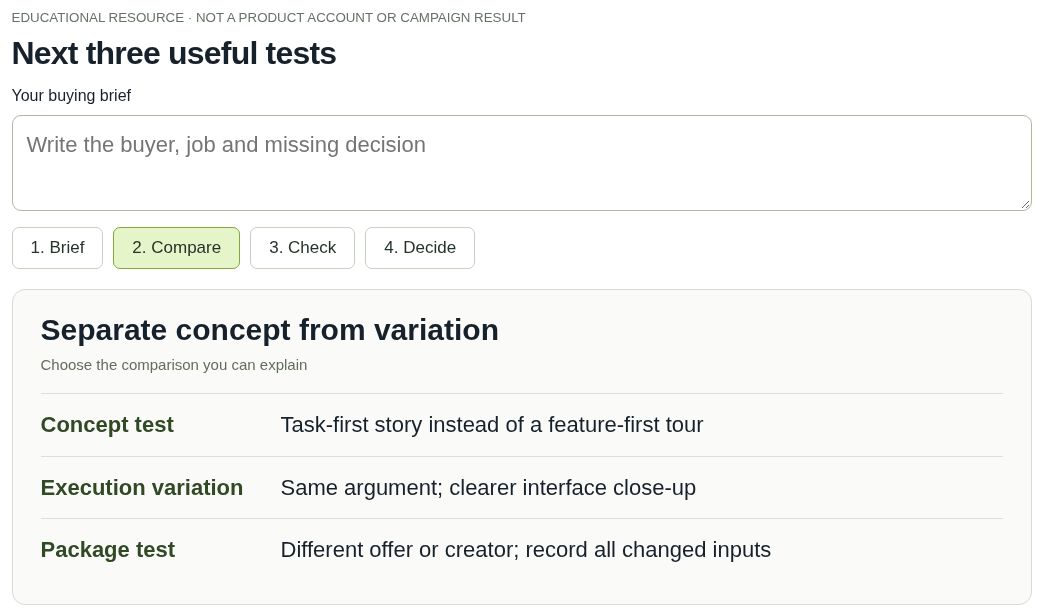
For the next round, keep the cable-drop concept and compare two edits. The control is the existing version. The challenger replaces only the first three seconds: it shows the cord sliding away in a tighter shot, and the cord’s plug stays in frame. Derive the challenger from the same source take and timecode range (0:00 to just before 0:03), not a different performance. The words, narrator, timing, remaining cut, music, offer, on-screen disclosure, caption text, destination and call to action stay the same. The claim is modest: the organizer holds the demonstrated cord in place. No promise about all cables, adhesive strength or how cleanly it removes goes into the script without support.
Make the hypothesis something an editor can check
“Make the hook punchier” can mean a closer crop, a louder sound, a new line or a different creator. Those are different orders. Use: “Does a closer shot make the slipping plug easier to understand? Purchase cost, not clarity alone, determines the next order.” Now the editor can freeze both cuts after second three and compare the remaining timeline. If the team also adds a discount graphic or an entirely different music bed, either remove it or change the test label to “opening package.” Don’t report a camera-framing effect after changing three things.
This decision can save you a shoot. If the source clip has enough resolution and shows the full plug, commission a crop from existing footage within your rights. If it doesn’t, quote a pickup with the same product and setup, but don’t call it a crop-only comparison if the performance, light or motion changes. Log the differences and label it an opening-package test, or wait for footage that lets you isolate framing. Don’t book four new creators to answer a question about framing. If the actual question is which creator better demonstrates the problem, write that as a different test with its own budget and allowable changes.
3. Design a comparison you can explain later
Use your platform’s experiment tool if it supports the account, campaign type, variable and outcome you need. TikTok’s Split Testing help describes mutually exclusive groups and a choice of testing variables, including creative. Google’s YouTube video experiment documentation describes comparing a control and treatment and notes that the basic creative-only path is limited to eligible campaign types. Check the current setup in your own account. Similar names and equal budget settings don’t mean two edits received equivalent exposure or were part of a controlled experiment.
Where an eligible split isn’t available, a same-period comparison can still show which problem is worth fixing, but treat the export as observational. Don’t claim the edit caused cheaper purchases. For a split, write down the audience and allocation, dates and time zone, budget by arm, placements, success metric, attribution settings and exact ad IDs before launch. Confirm whether automatic enhancements would change the opening or crop. Lock or consistently apply them if the point of the test is to isolate framing.
TikTok’s official Experiment Manager walkthrough documents a setup with separate Campaign A and B IDs, a test window and a key metric. Those are setup fields, not evidence of a result. On any platform, save the configuration that produced the report and match the export back to those exact arms. Once the test has started, capture a date-stamped settings record and keep it with the exports. Later, a tidy table with two rows won’t tell you whether an audience split or optimization setting changed mid-test.
Pick one outcome and set the guardrails
For this fictional purchase campaign, the primary decision metric is media cost per platform-attributed purchase. The three-second view rate, outbound click rate and landing-page activity help locate what happened, but none can independently approve more spending. Use the store for checks on stock, cancellations, event counts and order quality. Check that preview links and the finished ads point to the same available product and price on mobile. If the destination breaks for one arm, mark a comparability failure rather than scoring its ad.
Plan the spend from the baseline purchase rate and the smallest improvement worth acting on. If the brand’s first-order contribution reference is $27 after product, fulfillment, payment and expected return costs, it cannot set $40 as its scale target without an explicit, separate reason to spend above first-order contribution. This fictional brand uses $27 as a ceiling and $24 as a planning target to leave a $3 cushion. Those numbers come from the example’s economics, not a platform rule or a recommendation for another business.
A pilot with $300 per arm at an expected $36 acquisition cost might yield only eight or nine attributed purchases per arm. That is planning arithmetic, not a power calculation. Check projected testing power for your eligible experiment and choose an observation window that accommodates your normal conversion delay. If the affordable test is too small to answer the purchase question, use it for diagnosis only, or defer the paid test. Don’t swap to the prettier metric after looking at results and call it a sales decision.
4. Decide what would merit another dollar
Set a reading date and stopping rules before launch, including who can stop for safety or integrity. A broken checkout, unlawful claim, budget cap or wrong landing page is a reason to pause, document and repair. A favorable graph on day two isn’t a reason to stop early unless you designed the test for sequential decisions. When you read the report, compare spend, delivery and purchase counts together; check whether conversions have had time to appear under the recorded reporting window.
In the fictional example, the retrospective $36 for B is still above the $27 ceiling. A closer opening might be worth one limited test if the cost and evidence plan are defensible. It doesn’t justify a volume order or higher media budget on its own. If there isn’t enough traffic to test the forecast improvement, keep the package on hold and look for a cheaper way to check whether people understand the product. For example, have a colleague unfamiliar with the work describe the problem after watching each opening once. Use their answers to catch confusing footage, not to forecast conversion rates.
Decide how large an improvement would change the next order, not just how large a percentage looks good in a slide. In this example, $24 versus $36 would be a one-third reduction; $26 versus $36 might come in under the $27 acquisition ceiling but leave too little cushion to justify the added production cost. Set both the target and the minimum evidence in advance. A $24 snapshot on two purchases doesn’t meet this rule just because the arithmetic looks right. If there is no defensible purchase read, record that outcome rather than relabeling an attention result.
Keep three outcomes available
- Commission or extend: The predefined test is interpretable, the challenger clears the economic threshold, and the change is large enough to act on under the planned decision rule. Use the agreed scaled budget or next production scope; don’t assume the result transfers to another product, creator or placement.
- Investigate and run a narrower check: Attention improved but purchase evidence is inconclusive, or a delivery difference needs explanation. Save both cuts and the original export, inspect the broken step, then define the next check. No volume commission while the main result is unresolved.
- Stop or keep the control: The edit fails the business threshold, or the gain isn’t big enough to cover its costs. If the product offer or checkout is the more plausible issue, fix it before paying for more footage.
Count creator fees, usage rights, editing and internal review separately from media. In this example, an $80 editor fee, $40 internal review allowance and $60 in additional rights total $180, assuming those rights are available and needed. Add $600 of media and the cash editor and rights costs are $740 in total external spending, or $780 including the modeled internal time. At 20 attributed purchases for the full test, the blended spend would be $30 media per purchase, $37 including external production, or $39 with internal time. These are illustrative allocations, not a substitute for the per-arm result, not profitability, and not observed client costs. Confirm what is already covered before paying for rights twice.
5. Turn the decision into a creator brief
Next brief: cable-drop opening, version 2. The diagnostic question is whether an unmistakable view of the slipping plug makes the problem clearer. Judge the next order by cost per platform-attributed purchase, the $27 ceiling, the $24 planning target and the minimum purchase evidence set before launch. The ceiling is a first-order contribution reference, not proof that acquiring a customer is profitable. Approve the narrower edit or pickup and a fixed media test only if the buyer can define how much purchase evidence the budget could reasonably produce. The existing ad remains the control. The earlier makeover is context; it is not the next test arm.
| Field | Filled instruction for the fictional team |
|---|---|
| One change | Use the same source take and frame timing. Tighten only the crop during 0:00–0:03 so the falling plug stays visible against the desktop. |
| What stays fixed | Actor, words, timing, music, offer, captions, disclosure, rest of footage, landing page, product and test settings. |
| Truthful demonstration | Use the same organizer and cable shown in the control. Don’t claim other sizes fit or make adhesive claims without evidence. |
| Deliverable | One new 9:16 cut at the original duration, with approved captions, plus a source timeline showing the boundary at second three. |
| Acceptance | Watch the cuts side by side: before 0:03, verify the same action and timing; from 0:03 on, verify picture and sound match. On mobile, check the plug and disclosure both remain visible. |
| Usage | Confirm the agreement covers edits and the planned paid placement and duration. Brand or creator-account eligibility is a separate approval where applicable. |
| Measurement | Buyer records ad IDs, dates, attribution window, primary purchase cost, supporting counts and intended decision rules before approving spend. |
| Decision owner | Buyer signs off on the read; creative lead approves the cut; whoever owns the rights approval confirms the written terms before launch. |
Before the handoff, attach the control file, the timestamp of the intended crop, the approved product facts and the rights note. Label what the editor may change without asking. For this brief, holding the shot longer would change timing and requires approval. If the recording can’t keep the plug in frame at a usable resolution, return the request with a pickup quote instead of substituting glamor footage. If the video includes a US-facing endorsement, a crop must not hide its disclosure. The FTC’s disclosure guidance explains why a material connection belongs with the endorsement and, for video, in the video itself. That keeps the next experiment tied to the actual question rather than to what happened to be easiest to make.
For a new creator, use the same hypothesis to evaluate relevant work. Look for an example where they explain a small physical problem without cutting away too soon. Ask for permission to use references if needed; a portfolio sample isn’t paid usage. QuickAds sells Remy, its AI-assisted creator workflow, and publishes this guide. Use creator-sourcing software to collect evidence of fit and keep unresolved questions with the brief. It doesn’t validate an ad result or approve a creator’s claims. For a larger measurement plan, use the separate ad creative testing guide.
Make the next decision readable in one line
Use this structure when the report comes back: We tested [change] against [control] for [window], held [conditions] fixed, observed [metric, spend and counts], couldn’t verify [limitation], and decided [action and owner].
For the fictional retrospective above: “B cost $36 per attributed purchase on $360 and 10 purchases; A cost $60 on $480 and eight purchases. These were different packages under optimized delivery. Keep B as the framing-test control, not as a proven winner. Ask the editor for one revised opening and have the buyer check that a purchase test is affordable.” The record gives the next person enough detail to reproduce the calculation or disagree with the decision.
Questions before your next creative test
How many variations should I commission?
Commission the fewest versions needed for the question and the data available. One control and one challenger are enough for the specific opening test above. More cuts make sense if the questions, budgets, analysis plan and production work support them. Buying extra exports is not the same as buying meaningful comparisons.
Can I use results from an ad library to pick the next opening?
Use the footage to generate hypotheses, not to infer someone else’s return. You can learn that a seller uses a problem-first opening or puts the demonstration upfront. You usually can’t see their unit economics, comparable exposures and attributed orders. Note why an idea fits your buyer and put it through your own review and test.
What if the result is inconclusive?
Record the cause you can substantiate. Maybe the status is “not enough purchases,” “one arm had a stock error,” or “attribution was not comparable.” Those each call for different actions. If a clean comparison still doesn’t support an order, leave the control alone. A useful brief can end with “don’t commission anything yet.”





Privacy is important to us, so you have the option of disabling certain types of storage that may not be necessary for the basic functioning of the website. Blocking categories may impact your experience on the website. View Our Privacy Policy


