
B2B Influencer Marketing Agency: Pilot Scope Checklist
Hire a B2B influencer marketing agency when you need someone to find credible experts, earn their participation and turn their knowledge into work your buyers can use. Before you pay for a roster or a retainer, ask the agency to show which buyer question it can answer, who can answer it and what you’ll own when the pilot ends.
TopRank Marketing is worth investigating for an expert-led content program. OST is worth investigating when expert participation is part of a broader B2B social or event program. If your team already knows the subject and can approve the work, a narrower creator search or production brief may be enough. QuickAds publishes this guide and sells creator software and services. The agency descriptions and case studies below were rechecked in November 2026. They are provider-reported examples. We did not buy a comparable pilot from either agency, and neither agency’s fees or staffing are assumed.
Start with the buyer decision, then decide what to outsource
Say you sell deployment software. The engineer who will run a rollout, the director who has to end a maintenance window on time, and the procurement lead who wants to understand switching costs have different questions. “Increase awareness with technical leaders” does not tell the agency which of those questions it should tackle. A more useful first brief is: help platform engineering leads decide what their team needs to practice before handing a rollback procedure to on-call staff. If you need the named expert to distribute it as well as contribute, put both in the bid. Otherwise one agency may quote participation while another prices distribution.
Bring one question you’ve heard in discovery or implementation calls, with identifying details removed. Ask the supplier for the contribution it would commission, the best evidence that a candidate can produce it, and where the intended buyer would encounter it. A practitioner who has actually designed rollback drills might write an excellent technical teardown. That does not show that the same person can explain what a VP should budget or reach the audience you want. Treat relevant expertise and relevant distribution as two different pieces of evidence.
There are three practical ways to buy the work. An agency-led program can own research, recruitment, interviews, production and coordination across teams. A narrower managed pilot can own one expert brief and one set of outputs while you retain the rest. A team with an editor, a knowledgeable reviewer and existing expert relationships may only need research and production support. Ask who owns each task if you introduce a new audience or format in the second month. You are buying work, not a label on a service page.
Ask for evidence before asking for names
A persuasive pitch should include a redacted example of a contribution, the assumptions behind the audience fit and a description of what the agency actually did. For an implementation audience, ask to see a practitioner explain a decision, show the constraints and name a situation where their approach fails. A widely shared conference clip may establish that the speaker presents well. It does not establish that the speaker understands your buyer’s deployment problem or reaches that buying role.
Ask the provider to label candidates as researched, contacted with authorization, interested or booked. A short list of researched people is useful, but it is not confirmed availability. Ask what happens if the best expert has a conflict, won’t participate or can contribute but won’t post. If the proposal says “access to 20 experts,” ask which stage that number describes and which outcome the supplier will stand behind.
Specialist agencies to compare
TopRank Marketing: expert-led content that can support a longer program
TopRank Marketing’s B2B influencer service describes strategy, expert identification and management, co-created content, events and measurement. Its Adobe case study describes choosing contributors for a specific EMEA marketing audience, building a content asset and distributing it across paid and organic channels. That makes it a relevant example for a buyer who needs an editor and a program around the experts, not just a list of creators. The results are reported by the agency and should not be used to forecast a new pilot.
Give TopRank a sample technical or buying question and ask how its proposed team would research it, interview a practitioner with an independent point of view and handle a disagreement with product marketing. Ask what belongs to the pilot and what assumes an ongoing program. If your only need is a single confirmed guest for a webinar you can already produce, compare a narrower scope rather than carrying a multi-format program in the quote.
OST: expert participation inside a B2B social or event program
OST’s B2B influencer service describes expert research, strategy, recruitment, contracts, communications, payments and reporting, with one-off and ongoing programs. Its Salesforce case study describes a UK and Ireland social remit, an expert and customer-advocate program, and live event coverage. It illustrates how expert participation can fit alongside social and event execution. It does not isolate what an individual expert caused or establish the availability of any expert for your category.
Investigate OST when the supplier needs to coordinate an event, related social work and the follow-up with experts. Ask which channels, markets and event roles it would staff, which are priced separately and what artifacts it would return to your team. If a highly technical paper is the only deliverable, ask for an analogous writing sample and the proposed editor; a strong social case alone doesn’t qualify the agency for that assignment.
Compare the offers on the exact same scope
Send both suppliers the same buyer question and ask for the actual team, a sample method and a price for the same deliverables. One agency might propose an interview, edited teardown and short clip. Another might add event coverage and distribution. Put the additional work in its own line rather than comparing totals as if both offers buy the same thing. Agency service pages establish what they offer in public; your proposal establishes what they will do for you.
A fictional pilot you can use to price an agency
Set the deliverables and the decisions they support
A fictional deployment-software team is targeting platform engineering leads at mid-market firms. The sales team wants a piece it can send after a technical discovery call, and the budget owner wants to see whether buyer questions become more specific. The team commissions one experienced platform engineer, one 35-minute interview, one annotated teardown, one short excerpt for the brand’s sales follow-up and a single handoff. The base fixture buys 90 days of buyer-only reuse in direct U.S. sales follow-up from delivery of the accepted work. It excludes expert posting, paid media and rights to amplify an expert’s post. The expert can explain the general trade-offs without saying they use or endorse the product. The deliverable should include a short section on when the approach is a poor fit.
Specify an acceptance test before scheduling the expert: the teardown answers the named question, distinguishes a product demonstration from general advice, includes an example the product team can reproduce, and removes or supports every material product claim. The short excerpt must make sense outside the full interview. Accept it only after the technical reviewer has checked its context and the rights owner has confirmed where it can run. The supplier has to return the final files, an approval log and the signed scope for reuse.
Set milestones against real dependencies. For example, agree the reviewer and expert fit in week one, run the interview and approve an outline in week two, and deliver after one consolidated review in week three. If a legal or technical approver is unavailable in week two, shift the production schedule or cut scope. The agency should not be forced to film an unapproved premise and absorb the cost of making it accurate later.
Separate cash, staff time and optional distribution
Fictional quote, not market pricing: $2,400 for agency research and coordination, $1,500 for the expert’s contribution, $1,700 for editing and production, and $400 for a specified sales-use licence. That’s $6,000 of cash committed before tax or media. No other third-party expenses are assumed in this fictional baseline. If the buyer expects eight staff hours at an assumed internal cost of $100 an hour, the planning estimate is $6,800, of which $800 is internal time rather than cash owed to the agency.
The optional $1,000 media budget raises modeled cash to $7,000 and total planning cost to $7,800 only after the buyer confirms separate written rights for paid brand use and, if promoting the expert’s post, obtains the applicable author and platform permission. This illustration assumes neither a separate paid-use licence fee nor an extra expert fee; add either when quoted. If rights or permission are missing, stop at the sales-only base scope and leave the media money uncommitted. A $5,300 competing quote that excludes the same $1,500 expert fee would become $6,800 in cash before any differences in production, rights or distribution. Compare the missing lines rather than the headline totals.
| Scope | External cash | Internal labour | Planning total |
|---|---|---|---|
| Base: 90-day direct U.S. sales use only | $6,000 | $800 | $6,800 |
| Optional paid media: separate rights and applicable expert-post permission, no extra fees assumed | $7,000 | $800 | $7,800 |
| Another bid: headline plus the missing expert fee | $6,800 | Not yet comparable | Not yet comparable |
Put caps and exclusions in the pilot scope. For example, settle who pays if the expert withdraws before filming, whether an alternate is pre-approved and what counts as a revision versus a new deliverable. Ask how much is due at kickoff and which amount depends on acceptance. A quote that assumes you provide a fully approved script also shifts editorial work to your team; budget time for it instead of comparing it with a quote that does the interview and writes the outline.
Make one bad outcome actionable
Imagine that the selected engineer can describe a failed rollback exercise but hasn’t used the buyer’s product. The agency returns a script that says the tool prevents outages. The technical lead has a sample deployment but no evidence for that claim. Put that line on hold. Ask for a rewrite that separates the engineer’s experience from the brand’s demo; if the supplier won’t preserve that distinction, don’t accept the contribution. Shorten the brief or walk away before paying for further distribution.
Now imagine that the piece is accurate and the expert is credible, but the audience response comes mostly from job seekers rather than platform leads. Keep a useful sales asset if the terms allow it. Do not renew the same distribution buy on the basis of views. If actual buyers find the teardown useful in discovery, the next experiment could change the channel or the expert’s distribution role without discarding the content format.
A different brief can change the right supplier
Take a second fictional buyer, a manufacturer that sells maintenance software through regional partners. It wants a trusted plant engineer to moderate a session at a trade event and one local trade newsletter to carry a practical follow-up. One bid supplies four polished clips and paid social management. Another offers moderator recruitment, a regional producer, approved recap copy and a record of who can reuse it. If the goal is to reach maintenance leads through the event and newsletter, the second bid fits the job even before either bid is cheaper. If sales already has a moderator and only needs footage for its own channels, neither full package may be necessary.
Before awarding that brief, ask the supplier for an example of technical moderation, proof it can handle the event’s language and audience, and a backup speaker with a relevant work sample. The reviewer should check whether the proposed engineer can explain when a manual inspection remains necessary rather than repeating a claim about automated maintenance. If no one can substantiate the story without disclosing a customer’s operations, use a labelled hypothetical or change the topic. Do not promise customer access to make the pitch look stronger.
Compare failure plans as closely as the creative samples. If the conference moves, does the contract allow the work to become a recorded interview? If the newsletter does not confirm publication, who can approve a substitute, and does the buyer keep the same reuse? A supplier that distinguishes booked distribution from a suggested outlet gives procurement something it can enforce. If the agency can only promise speculative coverage, buy the event contribution on its own terms and leave the press line out of the success criteria.
Finally, set the handoff for both examples. A sales lead should be able to find the approved version, a brief summary of who it is for and the date to stop sending it. A channel owner should be able to identify which paid use was authorized. If either person has to ask the agency what an approval meant, the asset is not yet ready to hand over.
Mark what your team still has to own
Approve claims and rights before the first cut
Give product, legal or brand review an explicit owner and a deadline. The technical approver verifies what the product and evidence establish, not just what sounds plausible. The supplier owns consolidated edits within the agreed scope. For a quote or reusable clip, record the contributor’s name and role, the exact version, relevant commercial relationship, permitted channels, term, territories and the allowed edits. Agree who removes or stops the asset if its rights expire. If the expert is paid to explain how they think about the problem, do not present the piece as independent product testing.
For US-facing endorsements, the FTC’s disclosure guide explains material relationships and clear disclosures. Give your reviewer the planned wording and where it will appear in the actual asset. If you want to promote an eligible individual post, LinkedIn’s Thought Leader Ads setup describes requesting the author’s permission. Use on a sales page, posting on a creator’s account and promoting that post are separate approvals. Have the relevant owners check specific obligations for each channel and market.
Decide what counts as a useful result
Pick the observation period before the work goes out. For the fictional team, a 30-day review could record questions from identifiable buyer roles where available, whether account teams actually used the teardown and the number of tracked actions from its agreed link. Define a qualified question: a platform lead asking about rehearsal frequency tells you more about fit than six generic compliments. Record missing data and count each account once for the agreed measure.
Keep exposure, response and commercial follow-up separate. A view or impression indicates exposure using the platform’s definition. A follow-up conversation can indicate that someone used the material. An opportunity that saw the asset along the way may have been influenced by many other things. If attribution is important, ask the agency what it can observe, which baseline or comparison you will use and where you will still have uncertainty. Don’t turn an observed interaction into a pipeline promise.
Where QuickAds fits, and where you need a specialist
QuickAds Remy is worth evaluating if you need to turn a brief into a reviewable creator shortlist or coordinate creator work on the channels it documents. The search workflow overview on that page explains how platform, niche, audience and location shape a creator search. Ask for an example of the shortlist and the reasons behind each suggestion before committing. Use a synthetic brief with no customer names, then confirm who screens professional credentials and who takes the next decision. We did not observe that B2B test; the product link is a walkthrough, not proof of practitioner access. Treat audience and content signals as screening information, not verification that someone has the professional qualifications your buyer expects.
Remy’s public discovery description identifies Instagram, YouTube and TikTok. It does not establish native LinkedIn practitioner discovery or access to a particular B2B expert. If the assignment depends on niche credentials, institutional relationships, executive interviews or a LinkedIn-first expert network, start with the relevant specialist or your own subject-matter team. If you still evaluate QuickAds managed services, ask which scouting, editing and coordination steps are included in writing and who approves technical claims. Consumer creator rates are not a quote for practitioner participation.
Copy this into your request for a pilot
- Buyer and question: Who is the asset for? What decision should it help them make?
- Expert evidence: What relevant work demonstrates direct expertise? What evidence supports audience fit? Is availability confirmed, and how are conflicts disclosed?
- Deliverables and review: What files and source materials come back? Who interviews, fact-checks and gives final approval? What is an in-scope correction?
- Rights and distribution: Who may publish or reuse each version, on which channels and for how long? Is there a separate permission for paid use of an individual’s post?
- Price and decision: List agency fees, expert fees, production, rights, optional media and buyer hours separately. Set a review date and name one thing that would justify renewing.
For an editable example, open the QuickAds B2B expert-pilot kit and choose 4. Decide. Record the technical buyer question, what needs approval and what to review separately from revenue attribution.
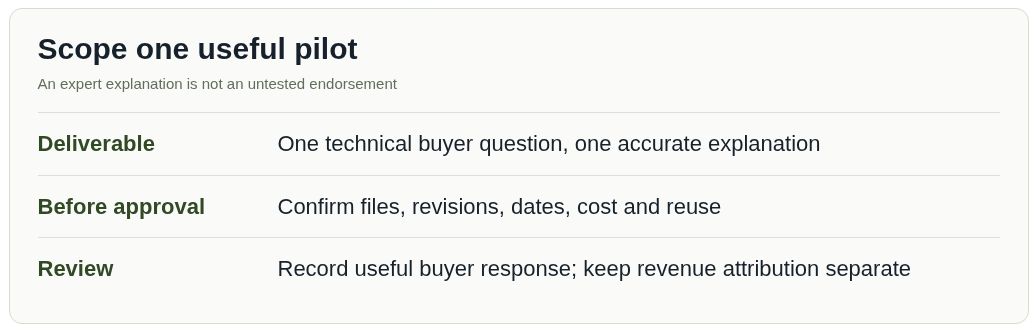
If you are still deciding whether the channel belongs in your plan at all, start with the broader B2B influencer marketing guide. If you already have a buyer question and need help with the creator side, see the QuickAds creator workflow. Ask for the proposed ownership and deliverables before you commit.




Privacy is important to us, so you have the option of disabling certain types of storage that may not be necessary for the basic functioning of the website. Blocking categories may impact your experience on the website. View Our Privacy Policy


